

SDV 平台提供了一组 API,用于 OEM 提供的诊断管理器与 SDV 服务软件包之间,以及用于支持 OEM 诊断用例的实用程序和通用平台功能。诊断对于我们为 OEM 提供的 SDV 工作、汽车服务和技术至关重要,因为诊断堆栈是任何汽车操作系统的重要组成部分。
OEM 会部署诊断管理器实例(通常每个 ECU 或每个虚拟机一个),通过与系统上的 SDV 服务软件包通信来处理诊断客户端的请求。为此,SDV 提供了一组标准诊断 API、实用程序和整体平台支持,以满足 OEM 诊断用例的需求。我们的目标是:
- 让 OEM 能够根据 UDS 标准实现诊断管理器。
- 允许诊断管理器将测试人员请求委托给 SDV 服务软件包。
- 允许 SDV 服务软件包以与车辆无关的方式公开诊断数据。
为此,SDV 提供了一组 API 来标准化 SDV 服务软件包(可能由第三方提供)与 OEM 的诊断堆栈实现之间的交互。
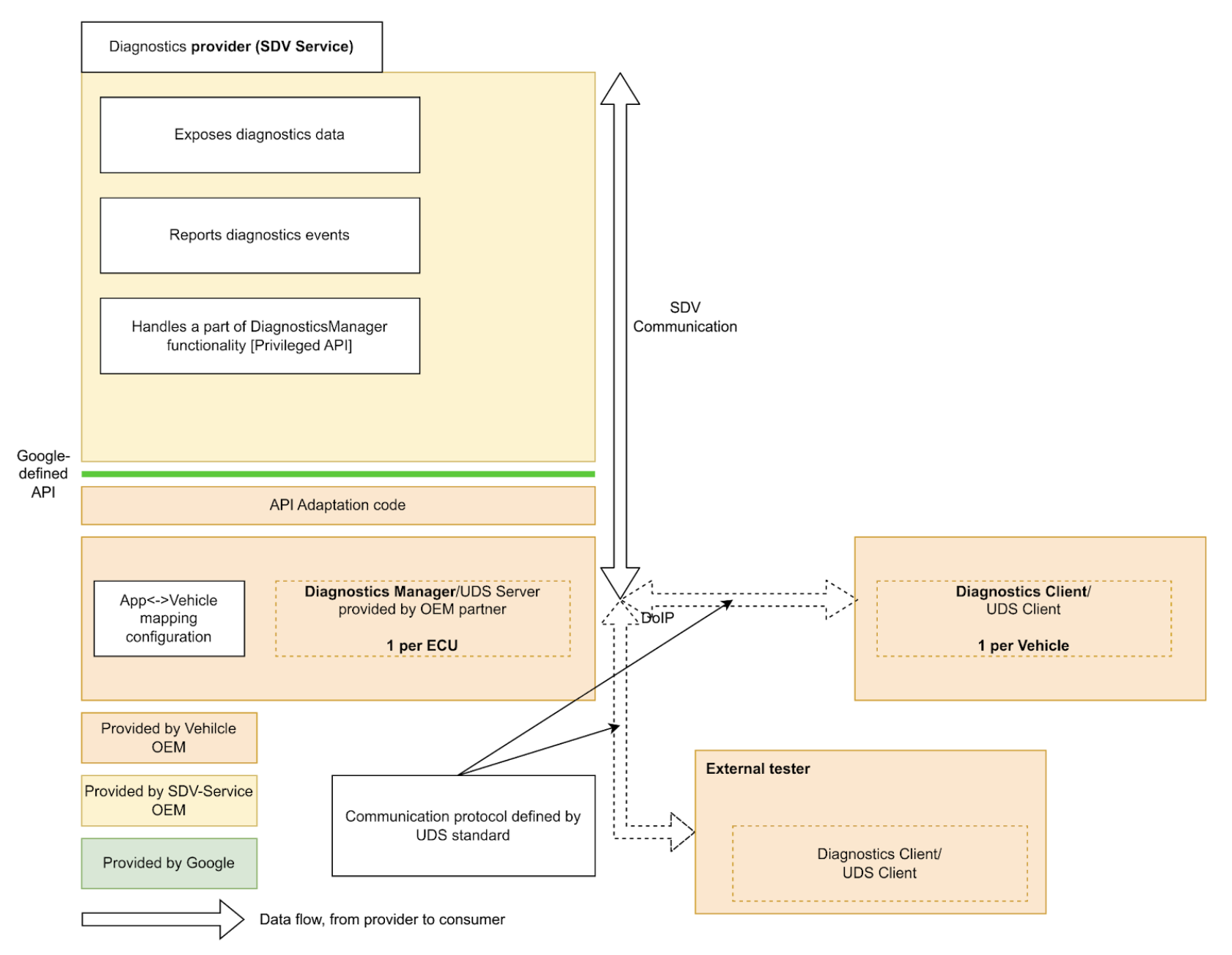
SDV 服务软件包可以公开诊断数据和实体、实现诊断功能,并向诊断管理器报告故障。
通过提供标准化的 SDV 范围诊断 API,我们简化了 SDV 服务包的实现,避免了重新实现诊断以在不同 OEM 的不同车辆上运行的需求。
Diagnostics Services API
SDV Diagnostics API 定义了以下服务,这些服务对应于特定的 UDS (ISO 14229-1) 服务:
service AuthenticationService:0x29(身份验证)。它提供了一种机制,让客户端能够证明自己的身份,从而访问受限数据或服务。service DataItemService:0x22(ReadDataByIdentifier)和 0x2E(WriteDataByIdentifier)。它允许读取和写入由 DID 标识的数据元素。service EcuResetService:0x11 (ECUReset)。它允许测试人员请求重置 ECU。service FileTransferService:0x34(RequestDownload)、0x35(RequestUpload)、0x36(TransferData)、0x37(RequestTransferExit)和 0x38(RequestFileTransfer)。它负责处理文件下载和上传的启动和处理。service IoControlService:0x2F (InputOutputControlByIdentifier)。它允许外部测试人员控制系统的输入和输出,以进行测试。service RoutineControlService:0x31(RoutineControl)。它允许测试人员启动、停止和请求由 SDV 服务实现的特定例程(函数)的结果。service SecurityAccessService:0x27(SecurityAccess)。它管理解锁特定安全级别所需的种子和密钥交换。
SDV 诊断 API 还基于 AUTOSAR 的诊断事件管理器 (AUTOSAR_SWS_DiagnosticEventManager) 定义了 service FaultListenerService 和 message Event,从而使应用能够报告诊断事件和故障。
此外,service DiagnosticsManagerService 还定义了一项 SDV 平台服务,可让其他服务查询当前的诊断连接参数(源地址、目标地址)和会话类型。
服务包开发者指南
作为服务软件包开发者,您可以在相应的 .vsidl 文件中定义 diagnostics_declaration 和以下服务器:
service_bundle {
    name: "<BUNDLE-NAME>"
    ...
    server {
        service: "com.sdv.google.diagnostics.data_item.DataItemService"
    }
    server {
        service: "com.sdv.google.diagnostics.routine_control.RoutineControlService"
    }
    server {
        service: "com.sdv.google.diagnostics.io_control.IoControlService"
    }
    server {
        service: "com.sdv.google.diagnostics.fault.FaultListenerService"
    }
    ...
    diagnostics_declaration {
        data_item {
            ...
        }

        routine {
            ...
        }

        event {
            ...
        }

        io_control {
            ...
        }
    }
    ...
}
DiagnosticsDeclaration 消息的定义如下:
package sdv.diagnostics.v1;

message DiagnosticsDeclaration {
  // Diagnostics data item declaration.
  //
  // See com.sdv.google.diagnostics.data_item.DataItemService service.
  message DataItem {
    // Required. Id of the data item.
    string id = 1;

    // Required. Fully qualified name of the message that defines a structure of
    // the data item.
    string message_name = 2;

    // Flag that indicates whether the data item is writable by the Diagnostics
    // Manager.
    //
    // Effectively, this indicates whether the call to DataItemService::Write,
    // is supported for this data item id.
    bool is_writable = 3;
  }

  // Declaration of diagnostics data for input/output control.
  //
  // See com.sdv.google.diagnostics.io_control.IoControl service.
  message InputOutputControlData {
    // Id of the input/output control data.
    string id = 1;

    // Fully qualified name of the message that defines a structure of the data.
    string message_name = 2;
  }

  // Declaration of diagnostics routine.
  //
  // See com.sdv.google.diagnostics.routine_control.RoutineControl.
  message Routine {
    // Information about routine control method.
    message Method {
      // Fully qualified name of the request message.
      string request = 1;

      // Fully qualified name of the response message.
      string response = 2;
    }

    // Id of the routine.
    string id = 1;

    // Information about routine start method.
    //
    // See com.sdv.google.diagnostics.routine_control.RoutineControl::Start.
    Method start = 2;

    // Information about routine stop method.
    //
    // See com.sdv.google.diagnostics.routine_control.RoutineControl::Stop.
    Method stop = 3;

    // Information about routine result method.
    //
    // See
    // com.sdv.google.diagnostics.routine_control.RoutineControl::RequestResult.
    Method result = 4;
  }

  // Declaration of diagnostics event and corresponding fault listener.
  //
  // See com.sdv.google.diagnostics.event.Event.
  // See com.sdv.google.diagnostics.fault.FaultListener.
  message Event {
    // Id of the event.
    string id = 1;

    // Fully qualified message name of the event's extended data message.
    string extended_data_message_name = 2;

    // Fault status changes which service wants to be notified of.
    //
    // See com.sdv.google.diagnostics.fault.FaultListener.StatusMask.
    uint32 fault_listener_mask = 3;

    // User-defined service unit name of a corresponding event publisher.
    string service_unit_name = 4;
  }

  // Diagnostic data items exposed by the service bundle.
  repeated DataItem data_item = 1;

  // Diagnostic data exposed for input/output control by the service bundle.
  repeated InputOutputControlData io_control = 2;

  // Diagnostic routines exposed by the service bundle.
  repeated Routine routine = 3;

  // Diagnostic events sent by the service bundle.
  repeated Event event = 4;
}
如果目录中定义了上述内容(包含 diagnostics_declaration 的 service_bundle 块),则 vsidl_rc_generator 会为每个声明了上述服务器和 diagnostics_declaration 的服务包生成 prebuilt_etc 目标:
prebuilt_etc {
    name: "<APEX-NAME>.<BUNDLE-NAME>-diag-config.binpb",
    filename: "DiagService-diag-config.binpb",
    sub_dir: "vsidl_provider",
    src: ":generate_vsidl_files_single_bundle_<APEX-NAME>.<BUNDLE-NAME>{diagnostics-config.binpb}",
    installable: false,
}
必须将这些目标添加到相应 apex 定义块的 prebuilts 中,如 prebuilt_etc {} 块上方的相应自动生成的注释块所示:
apex {
    name: "<APEX-NAME>",
    ...
    prebuilts: [
        ...
        "<APEX-NAME>.<BUNDLE-NAME>-diag-config.binpb",
        ...
    ],
    ...
}
您还必须在相应 sdv_service_bundles_manifest.textproto 文件的 bundle 的 sdv_service_bundle_metadata 条目的 diagnostics_config_path 字段中添加这些目标。此外,您必须指定授权政策,以在服务软件包和诊断管理器服务之间启用 RPC 通信:
sdv_service_bundle_metadata {
  name: "<BUNDLE-NAME>"
  ...
  diagnostics_config_path: "etc/vsidl_provider/<BUNDLE-NAME>-diag-config.binpb"
  authorization_policy_path: "etc/authz/permissions.textproto"
  ...
}
permissions.textproto 文件中的权限应定义客户端或服务器角色。例如,如果服务软件包实现了诊断数据项:
server {
    service: "com.sdv.google.diagnostics.data_item.DataItemService"
    allow_all_channels: true
}
平台开发者指南
作为平台开发者,OEM 必须实现诊断管理器代理 rust_binary 目标:
rust_binary {
    name: "<DIAGNOSTICS-AGENT-BINARY-EXECUTABLE-NAME>",
    ...
    product_specific: true,
    ...
}
此外,在 build 文件中,必须设置/覆盖以下变量:
SDV_DIAGNOSTICS_AGENT_MODULE := <DIAGNOSTICS-AGENT-BINARY-EXECUTABLE-NAME>
为方便起见,libsdv_uds_serde_v1 库可用于 Proto ↔ UDS 转换,而 VSIDL 提供程序库可用于反射。
诊断代理 .vsidl 文件应包含以下内容:
package: "com.sdv.oem.diagnostics"

service_bundle {
    name: "DiagnosticsAgent"

    server {
        service: "com.sdv.google.diagnostics.DiagnosticsManagerService"
    }

    client {
        service: "com.sdv.google.diagnostics.data_item.DataItemService"
    }

    client {
        service: "com.sdv.google.diagnostics.routine_control.RoutineControlService"
    }

    client {
        service: "com.sdv.google.diagnostics.io_control.IoControlService"
    }

    client {
        service: "com.sdv.google.diagnostics.fault.FaultListenerService"
    }

    client {
        service: "com.sdv.google.diagnostics.ecu_reset.EcuResetService"
    }

    client {
        service: "com.sdv.google.diagnostics.security_access.SecurityAccessService"
    }

    client {
        service: "com.sdv.google.diagnostics.authentication.AuthenticationService"
    }

    client {
        service: "com.sdv.google.diagnostics.file_transfer.FileTransferService"
    }
}
由于诊断管理器代理是一个二进制可执行文件,因此软件包的 sdv_service_bundle_metadata 被定义为仅配置声明:
sdv_service_bundle_metadata {
    # This name must match the agent's Bundle Name
    name: "DiagnosticsAgent"
    version_number: 1
    version_name: "1"

    # Reference the manifest itself to mark this as a config-only declaration.
    native_library_path: "etc/sdv_service_bundles_manifest.textproto"

    authorization_policy_path: "etc/authz/permissions.textproto"
}
诊断代理授权政策应定义其所交互服务的权限。例如,如果它调用了文件传输服务:
client {
    service: "com.sdv.google.diagnostics.file_transfer.FileTransferService"
    allow_all_channels: true
}